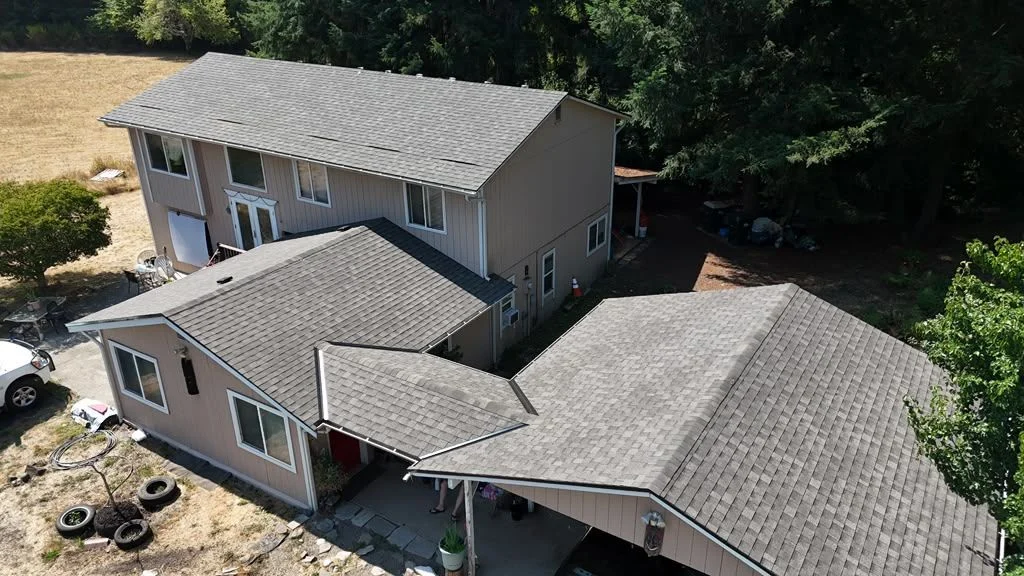
This Vancouver homeowner wasn't dealing with a leak. Nothing had failed, nothing was dripping into a bedroom, and there was no insurance claim behind the call. They booked a roof inspection because they wanted to know where their roofing system stood, and whether they were looking at a repair, a replacement, or a few more years of nothing at all.
The shingles gave us the answer to that question. The attic gave us a second one nobody had asked.
Project at a Glance
| Label | Details |
|---|---|
| Service | Roof Replacement, following inspection |
| Location | Vancouver, WA |
| Duration | 2.5 days |
| Budget Range | Contact us for a quote |
| Materials | IKO Cambridge Architectural Shingles |

What the Shingles Were Saying
From the ground, an aging roof usually looks fine. From above, it stops being a matter of opinion.
The field had gone blotchy, with lighter patches across the slopes where granules had worn away. Those granules are the shingle's sunscreen and its armor. Once enough are gone, the asphalt underneath hardens and shrinks under UV, and the shingle loses the flexibility it needs to stay sealed during a wet winter.
Streaking Isn't the Problem. The Pale Patches Are.
Most Vancouver homeowners notice dark streaking and assume the roof is failing. Usually, it isn't. Streaking is typically algae, a nearly universal issue in Western Washington. On its own, it's cosmetic. What actually ends a roof's life looks like the opposite: pale, patchy areas where the granule layer has thinned. That's what we were looking at here. In shaded neighborhoods like
Felida and Salmon Creek, moss holds moisture against the mat and strips granules faster.
Wear in One Spot vs. Wear Everywhere
The wear was consistent across every plane, not concentrated in one spot. That distinction separates a
repair from a replacement. Damage in one area, from a branch or a failed flashing, is a repair. Uniform wear means the material has reached the end of its service life, and patching buys a season while the rest keeps aging.

The Part Nobody Had Gone Looking For
A roof has to manage air as well as water, and the air aspect is where trouble hides.
This one was relying on a handful of low-profile vents scattered across a wide, cut-up roof, with no continuous ridge venting anywhere on it. For the size of the structure, that's thin.
Why Vancouver Attics Stay Wet
We don't get the hard, dry cold that freezes moisture out of the air. Vancouver parks in a damp groove for months, temperatures in the 40s and humidity high enough that nothing dries. Warm, moist air rises out of the living space into the attic year-round. With balanced intake at the eaves and enough exhaust up high, it moves through and leaves. Without it, that moisture condenses on cold sheathing night after night throughout the wet season.
Sheathing fails from underneath. It darkens, then delaminates, then goes soft. None of it visible from the driveway or inside the house. Douglas fir plywood, which decks a great many older Clark County homes, isn't forgiving about sustained dampness.
If Your House Was Built in the 80s or 90s
If your house went up during Clark County's building boom, this arrangement will look familiar. Scattered box vents, often called turtle vents, with minimal soffit intake was standard builder practice in a lot of those subdivisions. It was normal at the time. It still isn't enough for thirty years of Pacific Northwest attic moisture, and it's one of the most common things we find on roofs from that era.
None of this was what the homeowner called about. However, it still mattered because a new roof over an unchanged ventilation system inherits the problem on day one.
Addressing the Issue While the Roof Was Already Open
Correcting attic ventilation means getting onto the roof, cutting new penetrations, and flashing them properly. With the shingles already off, that's part of the job. Once the roof is sealed, it means opening up a roofing system somebody just paid for. Gaining proper access is the expensive part, and this homeowner paid for it once.
The ventilation review happened during the replacement. Intake and exhaust were brought up to what the structure needs. The finished roof carries exhaust venting distributed across the ridge lines and upper slopes, a substantially different arrangement from the scattered few that came off.
Rebuilding the Roof, Layer by Layer
Full tear-off, then inspection of the exposed decking. New drip edge and flashings at every transition. Waterproof membrane in the valleys, which on a roof with this many gables and hips is where volume concentrates and where winter Gorge winds drive rain sideways and push water uphill against the lap. Synthetic underlayment across the deck. Starter shingles around the perimeter, then IKO Cambridge architectural shingles fastened to the manufacturer's nailing pattern, hip and ridge caps matched to the field. Pipe boots and vents replaced rather than reused, since old boots are one of the most common sources of leaks on a sound roof.
Two and a half days from tear-off to cleanup.
If You're Not Sure Whether You Need a Repair or a Replacement
That uncertainty is why most Clark County homeowners reach out. Roofs degrade quietly through years of damp Northwest weather, and the real problems usually develop in areas that can’t be seen from the ground.
An inspection answers the question you brought and checks the ones you didn't know to ask. Ours covers the exterior, the interior, and the attic. If your roof has years left, that's exactly what we'll tell you. RedBird Roofing is family-owned, licensed, and insured in Washington and Oregon. If your roof still has plenty of life left, we’ll tell you—because being honest today is how we earn your business when you actually need a replacement down the road.
If you're weighing your options, our On The Fence page covers the repair-versus-replace decision in more detail.
Book a
free roof inspection or call us at
(360) 605-3127 to find out where your roof stands before the wet season starts.