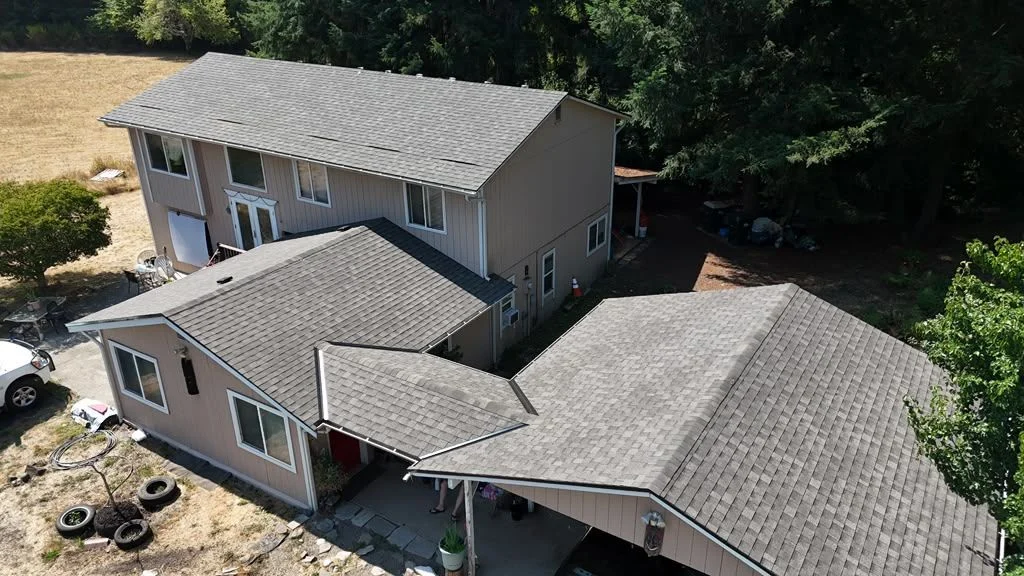
In the ridge vent vs. box vent decision, the right choice depends on your roof's geometry. Ridge vents run continuously along the peak and provide the most even airflow on simple gable roofs with full soffit intake. Box vents are individual units placed near the ridge and perform better on hip roofs, dormers, or intersecting rooflines where a continuous ridge is too short to work. On a standard gable roof, the costs are comparable: about $400 to $500 for a 40-foot ridge vent versus $300 to $900 for the six or so box vents a hip roof typically needs.
The common belief that ridge vents are always superior and box vents are outdated isn't accurate. Both exhaust warm, moist air the same way; they just do it from different positions on the roof. In the Portland and Vancouver climate, where the main job of ventilation is moisture control, matching the vent type to your roof shape is what keeps condensation from saturating insulation and rotting the roof deck. RedBird Roofing evaluates exhaust ventilation on every roof replacement project because the vent type directly affects how long the new roof lasts.
This guide breaks down how each works, what each costs, and which fits your roof.
How Ridge Vents and Box Vents Actually Work

Ridge vents and box vents serve the same purpose: they exhaust warm, moist air from the attic space. The difference is how they do it and where they sit on the roof.
Ridge Vents
A ridge vent runs continuously along the peak of the roof, hidden beneath a cap of shingles. As wind passes over the ridge, it creates a low-pressure zone that draws air upward through the vent opening. Meanwhile, cooler air enters through soffit vents at the eaves, creating a natural convection loop that ventilates the entire attic space evenly. This continuous design eliminates hot spots and dead zones that can trap moisture.
Ridge vents work best on roofs with a single, uninterrupted ridgeline and full-length soffit intake on both sides. The roofing underlayment beneath the vent opening must be cut back to the ridge board rather than sealed over, or the airflow path is blocked before it starts.
Box Vents
Box vents, also called static vents or turtle vents, are individual units installed in cutouts near the ridge of the roof. Each vent covers a defined area of attic space, typically 150 to 300 square feet, depending on the vent size and local code requirements. They rely on the same thermal convection principle as ridge vents but provide point-source exhaust rather than continuous coverage.
Box vents are the better choice for hip roofs where the ridge is too short for an effective continuous vent, for complex rooflines with multiple intersecting planes, and for sections of roof that sit far from the main ridge. A typical home with a hip roof might need four to eight box vents to achieve adequate exhaust.
Performance, Cost, and Which One Fits Your Roof

Choosing between these two vent types comes down to roof shape, budget, and how your attic is configured.
Airflow Efficiency
Ridge vents provide the most uniform airflow when paired with continuous soffit intake, allowing the entire attic to “breathe” evenly. This is critical in the PNW where moisture management matters as much as heat removal. Box vents can create uneven airflow patterns if they aren’t spaced correctly, leaving sections of the attic with stagnant air that traps humidity.
However, a well-planned box vent layout on a hip roof outperforms a ridge vent installed on a short ridge that doesn’t provide enough linear footage for effective exhaust.
Installation Cost
Ridge vents typically cost $2 to $3 per linear foot installed, with a full ridge vent on a 40-foot ridgeline running $400 to $500 in materials and labor. Box vents cost $50 to $150 each installed, and a home requiring six vents runs $300 to $900 total.
For simple gable roofs, the costs are comparable. For complex rooflines requiring many box vents, the total can exceed the price of ridge vents. Both options add minimal cost relative to the overall roof replacement budget but deliver significant returns in roof longevity and energy savings.
PNW Moisture Considerations
In the Portland and Vancouver area, the primary job of roof ventilation is moisture control. Portland averages over 40 inches of rain annually, and homes in Hillsboro and Washington County face similar conditions.
Warm indoor air rising through ceiling gaps carries moisture into the attic, where it condenses on cold roof sheathing during winter. Without adequate exhaust ventilation, that condensation saturates insulation, promotes mold, and rots the roof deck from the inside.
Ridge vents with external baffles handle wind-driven rain better than older box vent designs, though modern box vents with built-in rain screens have largely closed that gap.
Frequently Asked Questions
Can you mix ridge vents and box vents on the same roof?
Mixing ridge vents and box vents on the same roof is generally not recommended. Box vents placed below a ridge vent can short-circuit the airflow by pulling air in through the box vents instead of through the soffit intake. This reverses the intended convection pattern and reduces overall ventilation. If your roof requires both types due to its geometry, a roofing contractor should design the layout so each vent type serves a separate, isolated attic area.
How many box vents does a typical Portland-area home need?
Most homes in the Portland and Vancouver area need one box vent for every 150 to 300 square feet of attic space, depending on local code and whether the system includes balanced soffit intake. A 1,500-square-foot attic typically requires five to ten box vents for adequate exhaust. The exact number depends on the vent size, roof pitch, and whether any soffit venting supplements the exhaust capacity.
Do ridge vents leak in heavy rain?
Quality ridge vents with external baffles and weather filters don’t leak under normal conditions, including heavy Pacific Northwest rain. Older or improperly installed ridge vents can allow wind-driven rain into the attic, but modern products from manufacturers like Lomanco and Air Vent are designed to shed rain while maintaining airflow. Proper installation with the correct shingle cap overlap is the most important factor in preventing leaks.
Find the Ventilation Setup Your Attic Needs
The best roof vent matches your roof's geometry and provides balanced airflow with your intake system. For most homes with a standard gable roof in the Portland and Vancouver metro, a continuous ridge vent paired with full soffit intake is the most effective option. For hip roofs, multi-plane rooflines, or attics with structural obstructions, a properly spaced box vent layout delivers targeted exhaust where a ridge vent cannot reach.
RedBird Roofing assesses ventilation as part of every roof replacement and repair project. As a Malarkey Emerald Pro Certified contractor licensed in Washington and Oregon, RedBird ensures your ventilation design meets code, protects your warranty, and manages moisture through every PNW season.
Call (360) 605-3127 or request your free estimate to get a ventilation assessment with your next roofing project.