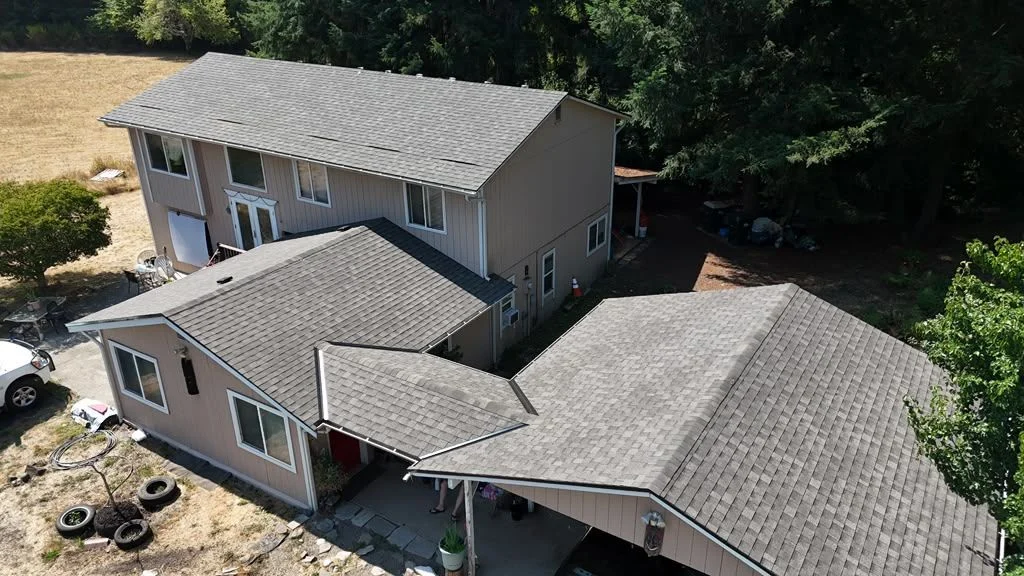
For most Portland and Vancouver homeowners weighing architectural shingles vs. 3-tab roofing, architectural shingles are the better choice. They last 25–30 years versus 15–20 for 3-tab, resist winds up to 110–130 mph compared to 60–70 mph, and carry stronger warranties. 3-tab shingles cost less upfront, but architectural roofs win when the cost of protection per year is factored in. This is because architectural shingles don’t need to be replaced as quickly. That said, 3-tab can still be the right call if you're working with a tight budget or don't plan to stay in the home long.
Both types of shingles go over the same plywood decking and use the same asphalt-and-fiberglass base, but the similarities end at construction. The difference in weight, lifespan, and wind rating is what separates them in the Pacific Northwest's wet, windy climate. After countless roof replacements across the Portland-Vancouver metro, RedBird sees the performance gap every year. This guide explains how they're built, what each costs over time, and which one fits your roof and budget.
How 3-Tab and Architectural Shingles Are Built Differently
The core difference is how they’re built. A 3-tab shingle is a single flat layer of asphalt with three uniform cutouts along the bottom edge. An architectural shingle (also called dimensional or laminated) bonds multiple layers of asphalt together into a thicker, heavier product with a textured appearance. That extra material changes everything about its performance.
Weight and Thickness
Architectural shingles weigh roughly 50% more per roofing square than 3-tab products. A typical 3-tab shingle weighs around 240 pounds per square (100 sq ft), while architectural shingles come in closer to 350 pounds. The added mass helps them stay put during windstorms and resist impact damage from hail or falling branches, both common across the Portland and Vancouver metro area.
Wind Resistance
Standard 3-tab shingles carry wind ratings of 60 to 70 mph. Architectural shingles are rated for 110 to 130 mph, with some premium products warranted even higher when installed with manufacturer-specified accessories. In the Columbia River Gorge corridor, where east winds regularly gust above 60 mph during fall and winter, that gap is a practical concern rather than a spec-sheet footnote.
Lifespan in the Pacific Northwest
In the PNW’s wet, mild climate, 3-tab shingles realistically last 15 to 20 years before granule loss and moisture exposure take their toll. Architectural shingles deliver 25 to 30 years under the same conditions. Moss growth, sustained rainfall, and UV cycles during long summer days all shorten shingle life, and the thicker multi-layer construction of architectural products handles that wear better over time. Picking the right shingle based on the climate and the condition of your roof adds years to what the base material rating suggests.
Cost, Warranty, and Long-Term Value Compared

Price is the main reason homeowners still consider 3-tab shingles. For a standard 2,000-square-foot home in the Portland or Vancouver area, here’s how the numbers break down:
- 3-tab installed cost: $8,000 to $12,000
- Architectural installed cost: $11,000 to $18,000
That is a significant difference—roughly $3,000 to $6,000 more for architectural, but the difference in cost becomes clearer when you consider how long each product lasts.
Cost Per Year of Protection
A 3-tab roof that lasts 17 years on a $10,000 investment costs about $588 per year of protection. An architectural roof that lasts 28 years on a $14,500 investment costs about $518 per year. Over a 30-year ownership period, the 3-tab option requires a full replacement cycle that the architectural roof avoids entirely. Add the cost of that second installation, and 3-tab ends up being the pricier option.
Warranty Differences
3-tab shingles typically carry 20- to 25-year limited warranties. Architectural shingles from manufacturers like Malarkey offer limited lifetime coverage for residential installations, with enhanced wind and algae resistance built into the warranty terms. When installed by a certified Malarkey Emerald Pro contractor, architectural shingles qualify for coverage that includes up to 130 to 140 mph wind resistance and algae-resistant granule technology designed specifically for wet climates like the Pacific Northwest.
Resale and Insurance Impact
Architectural shingles are now the industry standard. Homes with 3-tab roofs may appraise lower or face insurance scrutiny as carriers tighten underwriting standards around older roofing products. Major manufacturers have reduced available 3-tab product lines by more than 60% in the past five years, making color-matched partial repairs increasingly difficult. A new architectural roof adds measurable curb appeal and removes one of the most common negotiation points during home sales in Portland, Vancouver, and across the wider Portland-Vancouver metro.
Frequently Asked Questions
Are 3-tab shingles still available in Washington and Oregon?
Yes, but product selection is shrinking rapidly. Several major manufacturers have significantly reduced their 3-tab lines, and matching colors for partial storm damage repairs is becoming difficult. If your current 3-tab roof needs a section replaced, finding an exact color match may no longer be possible, which can force a full replacement instead of a targeted repair.
Can you install architectural shingles over existing 3-tab shingles?
Overlay installations are sometimes possible but generally not recommended. Adding a second layer masks potential deck damage underneath and can void manufacturer warranties. A full tear-off with deck inspection is the safer approach, especially in the Pacific Northwest where moisture trapped between shingle layers accelerates wood rot and shortens the new roof’s lifespan.
Do architectural shingles help with moss resistance in the PNW?
Architectural shingles with algae-resistant granules slow moss and algae growth compared to standard 3-tab shingles. Malarkey’s Scotchgard-protected products are specifically designed for this purpose. However, no asphalt shingle eliminates moss entirely in the Pacific Northwest. Regular maintenance and zinc or copper ridge strips remain the most effective long-term prevention strategy alongside algae-resistant shingles.
Choose the Shingle That Matches Your Roof and Budget

For most Portland and Vancouver homeowners, architectural shingles are the stronger long-term investment. They last longer, handle PNW wind and rain better, carry stronger warranties, and hold their value at resale. 3-tab shingles still make sense for tight budgets or short-term ownership, but the gap in lifetime value favors architectural products by a wide margin.
RedBird Roofing is a Malarkey Emerald Pro Certified contractor serving Vancouver, WA and Portland, OR. That certification means every architectural shingle installation qualifies for enhanced manufacturer warranties and is backed by RedBird’s own 25-year labor warranty. Call (360) 605-3127 or schedule your free estimate to compare shingle options for your roof.